Showing posts with label Missile. Show all posts

Sunday, May 5, 2013

AT-13 Saxhorn-2

Army and Weapons | AT-13 Saxhorn-2 | AT-13 Saxhorn-2, Czech CZ vz. 24 bolt-action service rifle in 1924 proved itself through many 20th-century conflicts AT-13 "Saxhorn-2" is an anti-tank missile system is man-portable Russian origin and is a modern form of the original AT-7 "Saxhorn". The main difference between the two systems is a new AT-13s missiles which sport larger dimensions, increased operational range and internal modern technology. It is produced by the KBP Instrument Design Bureau and entered service with the Russian Army in 1992 to serve with mechanical armored units.
KBP has a long history after their founding in 1927 in Tula and the company has gone on to produce a variety of anti-tank, anti-aircraft and anti-infantryweapon systems for Soviet military / Russia. Some countries Soviet / Russian-allied procurement has also moved a relatively new weapon systems to help modernize the power of anti-tank and including Croatia, South Korea, Iran and Syria. The Saxhorn-2 allows for on-the-spot, the point-defense against all types of armored vehicle when he was made to be very portable with thought given to the ease and effectiveness of use.
The Saxhorn-2 system consists of three main components which consist of 9M131F missile, launch tube and 1PBN86 9P151-VI thermal imaging sight. Standard operating crew of three personnel who are well shot action and facilitate transport of Saxhorn-2 system as a whole. Setup of Saxhorn-2 is about 15 seconds for a team of firefighters trained (transported with missile launch tube in place ready to fire) but missiles can only be fired from the standing or prone position.
Because reusable launcher, fire team can actually provide a semi-consistent rate-of-fire three missiles per minute. At least five missiles each team assigned Saxhorn-2 to facilitate reloading launcher fire. Because one of the missiles already in the launch tube with the major carriers, four other re-divided as between the two couples and the remaining personnel is done in addition to their personal weapons. The Saxhorn-2 system measures in at 980mm by 130mm diameter. Weighs about 13.8 pounds. Such as anti-tank missile system other than this class, Saxhorn-2 can also be fixed to fire on vehicles of various types, making for anti-tank weapons platform moves when needed.
The 9M131F missile engine features solid-fuel rocket booster that supplies the operational range between 0.08 and 1.5 kilometers (0.049 to 0.93 miles) - for the safety of the crew, weapons like these generally have a minimum operating range. Speed ​​at the height of the post-launch phase is about 656 meters per second (200 meters per second). Missiles were directed to the target via a wire link (wire-guided) who take orders and corrections have to provide pin-point accuracy relative.

The missile base is limited to the HEAT (High Explosive Anti-Tank) warhead designed to penetrate armor face. When equipped as such, 2-Saxhorn fire team can also launch missiles thermobaric warhead based on the personnel or structure. Thermobaric weapons blast wave expands traditional for adverse effects greater use of oxygen available nearby (as in a fuel-air bomb).
Army Israeli Merkava main battle tanks reportedly met Saxhorn-2s when fighting Hezbollah forces in Lebanon War in 2006. While Russia denies missile system sales to the group, this is believed to be obtained through its own connection Syrian anti-tank systems acquired from Russia. Russia was officially appointed as the 9K115 Saxhorn-2-2 'Metis-M'. AT-13 "Saxhorn-2" is the name of NATO.

Monday, July 30, 2012

Air-to-air missile

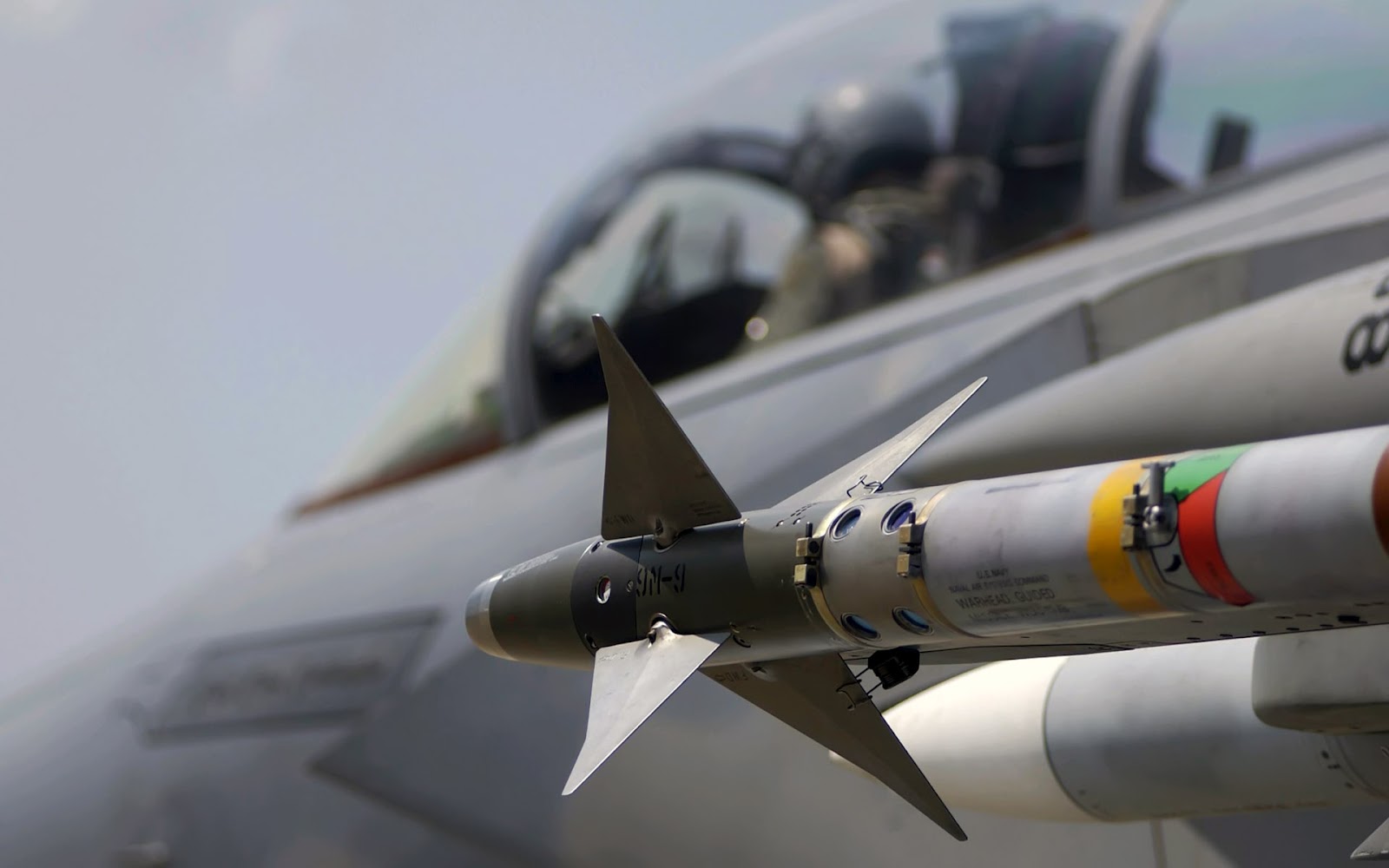
Army and Weapons | Air-to-air missile |  An air-to-air missile (AAM) is a missile fired from an aircraft for the purpose of destroying another aircraft. AAMs are typically powered by one or more rocket motors, usually solid fuelled but sometimes liquid fuelled. Ramjet engines, as used on the MBDA Meteor (currently in development), are emerging as propulsion that will enable future medium-range missiles to maintain higher average speed across their engagement envelope.
Air-to-air missiles are broadly put in two groups. Those designed to engage opposing aircraft at ranges of less than approximately 20 miles (32 km) are known as short-range or “within visual range” missiles (SRAAMs or WVRAAMs) and are sometimes called “dogfight” missiles because they emphasize agility rather than range. Most use infrared guidance and are called heat-seeking missiles. In contrast, medium- or long-range missiles (MRAAMs or LRAAMs), which both fall under the category of beyond visual range missiles (BVRAAMs), tend to rely upon radar guidance, of which there are many forms. Some modern ones use inertial guidance and/or "mid-course updates" to get the missile close enough to use an active homing sensor.

Kinds Of Missile  :

Warhead Missile
Guidance Missile
Radar guidance Missile
Active radar homing Missile
Semi-active radar homing Missile
Beam riding  Missile
Infrared guidance Missile
Electro-optical Missile
Passive Anti-radiation Missile
Missile Range :

Missiles are often cited with their maximum engagement range, which is very misleading. A missile's effective range is dependent on factors such as altitude, speed, position, and direction of target aircraft. For example the Vympel R-77 has stated range of 100 km. That is only true for a head-on, non-evading target at high altitude. At low altitude, the effective range is reduced by as much as 75%–80% to 20–25 km. If the target is taking evasive action, or in stern-chase position, the effective range is further reduced. See Air-to-Air missile non-comparison table for more information. The effective range of an air-to-air missile is known as the “no-escape zone”, noting the range at which the target can not evade the missile once launched.

Poorly-trained pilots are known to fire their missiles at maximum-range engagement with poor results. In the 1998–2000 Eritrean-Ethiopian War, fighters from both sides shot over a dozen medium-range R-27 (AA-10 Alamo) missiles at distance with little effect. But when better-trained Ethiopian Su-27 pilots gave chase and attacked with short-range R-73 (AA-11 Archer) missiles, the results were often deadly to the Eritrean aircraft.