Showing posts with label Sniper Rifle. Show all posts

Friday, March 22, 2013

Arctic Warfare .50

Army and Weapons |  Arctic Warfare .50 | AI Arctic Warfare .50 better known as the AW-50 is basically an improved AI Arctic Warfare to fire .50 BMG caliber ammunition. The AW-50 features anti-reverse system and has adjustable monopod at the back and a folding stock. To mount optics have a MIL Standard 1913 rail machined into the action. The AW-50 is the Arctic Warfare .50, modification of the AS-50 to trigger a bigger housing to fit gloved finger, a small straw bolt to stop the ice from the lock and muzzle brake for reduced recoil and muzzle flash. The AW-50F is the Australian version of the AW-50 with Australian-produced stock and barrel. This is done to take out radar installations, a small, light-vehicles and fortifications. AS-50 and AW-50 variant can use Raufoss MK211 cartridges. This is the standard round for the rifle in Australia.

Tuesday, January 1, 2013

Cheytac M200 LRSS

 Army and Weapons | Cheytac M200 LRSS | Cheytac M200 LRSS,  When the designers first started work on the rifle, the cartridge on which to base the rifle was in debate. Existing rounds, namely the .338 Lapua Magnum and the .50 BMG, were candidates, but eventually a new round was created, the .408 Chey Tac. Once the cartridge was designed, work was started on the rifle, which was built around the .408 Chey Tac cartridge.
The M200 was once available only to goverment purchasers, and a purposely made less accurate variant (the M200 Civilian Intervention Version, CIV) was sold to civilian purchasers because Cheyenne Tactical believed the standard M200 was 'too accurate' for civilians and they reportedly 'did not want their incredible technology to fall into the wrong hands'. However, Cheyenne Tactical stopped production of the CIV and the standard M200 is now available for civilan purchase because Cheyenne Tactical apparently realized that voluntarily supporting govermental supremacy is not a good business strategy. 
he first step in designing the M200 was creating the cartridge. Existing rounds, namely the .338 Lapua Magnum and the .50 BMG, were candidates, but eventually a new round was created, the .408 Chey Tac. Once the cartridge was designed, work was started on the rifle, which was built around the .408 Chey Tac cartridge. The rifle has an integral bipod, folding stock, and a seven-round removable magazine. Lastly, the Advanced Ballistic Computer is used to determine the wind speed, elevation, and other factors, which is then transmitted to the rifle. The rifle is then able to be fired accurately at ranges of over two miles. 

Sunday, December 2, 2012

KAC SR-16


Army and Weapons | KAC SR-16 | The SR-16 is a lightweight, magazine-fed, gas-operated, air-cooled, and shoulder-fired carbine. It features a 14.5 inch chrome-lined, ball milled, lightened barrel, and uses a mid-length gas system. Like the AR-15, it features an inline gas piston system which operates on expanding gas, using the pressure generated by the gas inside the hollowed-out bolt carrier to cycle the weapon. 
 
It features the KAC improved E3 bolt and barrel extension for greater parts life, and the improved bolt carrier (termed "Carbon Cutter") which is more resistant to fouling in adverse conditions. The SR-16 also features a pressure reduction buffer to reduce vertical recoil, a two stage match trigger, ambidextrous controls (magazine release, bolt release safety switches), and a SOPMOD style collapsible stock. It also comes with the URX rail (Upper Receiving Free Floating Rail System).
The SR-16 is a lightweight, gas-operated, magazine-fed, air-cooled, shoulder-fired weapons. They feed from box magazines, most of which are either the 20-round or 30-round variety (each variety, save for the 5-round magazines, should be downloaded by two rounds - 28 for 30, 18 for 20, etc. This makes it easier to load on a closed bolt). The magazines are the same magazines that the AR-15 uses. SR-16 rifles feature a bolt catch mechanism that holds the bolt open upon firing the last round in the magazine.
The magazine is inserted straight into the magazine well, and firmly pushed until a "click" is heard. Give the magazine a slight tug to make sure it does not come out. If the bolt is locked open, simply press the serrated "paddle" portion of the bolt catch in with the thumb to close the bolt and chamber a cartridge. If the bolt is closed, pull the charging handle to the rear and let it slingshot forward. The forward assist should not be needed unless the weapon isn't properly lubricated and is dirty. At this point, turn the selector switch to the mode of fire of choice (semi, auto), and fire the weapon. Once the magazine is empty, the bolt will lock open. It is good practice to always check the chamber for any obstructions prior to reloading.

Friday, August 3, 2012

Heckler & Koch PSG-1 sniper rifle from Germany

Army and Weapons | Heckler & Koch PSG-1 sniper rifle from Germany | The PSG-1 sniper system (PrazisionsSchutzenGewehr, or "high-precision marksman's rifle"in English) had been developed by the German company Heckler - Koch by themid-1980s as an ultimate police and counter-terror weapon. Some German elite law-enforcement groups, like GSG or KSK-9, participate in this development, and since its introduction the PSG-1 had been adopted by various police forces in Europe and Americas. It is way too heavy and somewhat too gentle for military use, so it never seen any military use.
Instead, HK developed two more sniper weapons. The first, that actually preceded the PSG-1, was the G3-SG1, an accurizedand scope-fitted version of the basic G3 automatic rifle for German Army. And in the mid-1980s HK also developed a derivative of the PSG-1, called MSG-90, for export military sales. The PSG-1 is still offered by the HK, and is one of the most expensive factory-made sniper rifles on the market, hitting the $10.000price tag in the basic package.
Caliber: 7.62 x 51mm NATO (.308 Win)
Action: Semi-automatic, roller-delayed blow back
Barrel: 650 mm
Overall length: 1208 mm
Weight: 8.10 kg with scope and no magazine
Magazine: 5 or 20 round detachable box
Scope: Hand soldt 6x42, 6 settings from 100 to 600 meters
Expected accuracy: Sub-1MOA with match grade ammunition

Technically, the PSG-1 is no more than a heavily modified G3 rifle. It features the same roller-delayed blow back action, derived from earlier C E T M E rifles, and the same stamped steel receiver with separate detachable trigger unit. The heavy barrel is precisely made by the cold hammer forging process with poly go rifling for improved accuracy and longer life. Special trigger unit features a semi -automatic only hammer group and the adjustable trigger with trigger pull of about 1.5 kg (3 lbs). The ergonomically shaped pistol grip features an adjustable palm stop. Plastic but stock is also adjustable for height and for length of pull. Another non-typical feature of the PSG-1 is the "silent bolt closing device", actually similar to the forward assist, found on M16rifles.
This is apparently to be used in situations where a complete silence must be maintained until the shot is fired. The devise is no more that a push button, located just behind the ejection port, and linked to the bolt carrier by the ratchet-like device. The rifle is fed using standard 20-rounds G3magazines or special 5-rounds magazines. There's no open (iron) sights on the PSG-1. Instead, it is fitted with the Hand sold  6X42 fixed power telescope sigh  illuminated reticle. The scope has built-in range adjuster that works in ranges from 100 to 60 meters, so 600 meters is considered the maximum effective range. Most strangely, the PSG-1 had no integral bipod. Instead, it is often used with the separate rest, mounted on the compact tripod.

Tuesday, June 12, 2012

H&K PSG-1


Army and Weapons | H&K PSG-1 | The PSG-1 is said to be the most accurate semi-auto in the world. There is a lot of other rifle manufacturers that will dispute this, but the PSG-1 has become the standard that the others must meet. The accuracy standard that all PSG-1's must meet is 50 rounds of match ammo into an 80mm (3.14") circle at 300m. (1 MOA). Keep in mind this is 50 rounds, not a 3 shot group. The PSG-1 is popular in some Special Op units and elite anti-terrorist units. It really does not lend itself well to the Military environment because of 2 reasons. First it ejects the shells about 10 meters, and this can easily give away a position, and also is a pain to try and police your brass to prevent leaving a target identifier. 
 
The second reason is that it only can be fitted with the Hensoldt 6x42 sight. No other sight can be used (Short of grinding off the mount and welding on your own type base). The 6x is only set up to be used out to 600 meters, and thats the start of the optimal engagement range for military snipers (From 600-700 meters). Rumor has it that H&K is addressing this problem and have came up with a different system that allows you to switch out scopes, but I haven't seen one of their new PSG-1's to confirm this. It is an outstanding Police Sharpshooter weapon, but most agencies cannot afford the price tag (about $9000 USD), which is why it usually shows up in only the most elite units.

Caliber:     7.62 x 51mm NATO (.308 Win)
Magazine:     5 or 20 round detachable box
Barrel:     25.59" (650mm), Heavy, 4 grooves, right hand twist.
System of Operation:     Roller locked, delayed blowback.
Overall length:     47.56" (120.8 cm)
Total Weight:     17.81 lbs (8.10kg)
Scope:     Hendsoldt 6x42, with reticle illumination. 6 settings
from 100 to 600 meters
Stock:     Matte black high impact plastic,
adjustable for length, pivoting butt cap,
vertically-adjustable cheekpiece; target-type
pistol grip with adustable palm shelf.
Trigger:     Adjustable for pull, removable from pistol grip.
Features:     Uses HK-91 action with low-noise bolt closing device;
special forend with T-way rail for sling swivel or tripod.

Tuesday, July 19, 2011

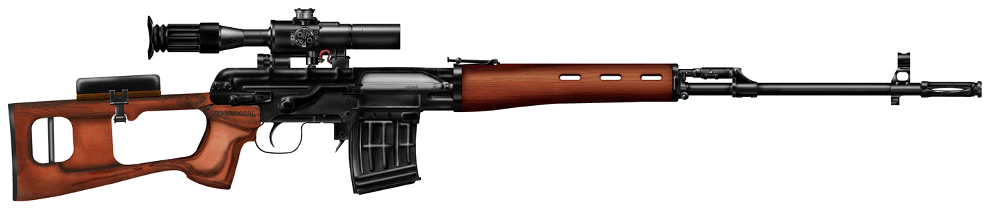
Deadly Dragunov Sniper Rifle

Army and Weapons | Deadly Dragunov Sniper Rifle  |  SVD Dragunov sniper rifle (Snayperskaya Vintovka Dragunova) The Dragunov, SVD Dragunov in particular, is one of the most popular sniper rifle in the world today. The Russian Dragunov SVD is considered, by collector, being one of the most precious trophy of all time, semi-automatic design Evgeniy Fedorovich Dragunov rifles from Russia between 1958 and 1963 .. The rifle is considered as the first military sniper rifle with high precision and is widely used by snipers in the countries of Eastern Europe.
SVD bullet Room 7.62 x 54R caliber, with a muzzle velocity of 830 m / sec,This gun can use the Mosin Nagant M1891/30 ammunition, but would be more accurate to 7N1 ammunition designed for SVD rifle. In 1999,7N14 7N1 amunusi replaced by a projectile weighing 151 grains. So far still not been marketed 7N14 ammunition to shoot off ekspor.Jarak SVD reach 1000 meters, but the most effective range is 600 meter.Standar SVD rifle including scope PSO-1 4x24 and a passive infra-red battery-powered filter.
SVD rifle continued to be modernized by Izhmash factory by eliminating the withholding exemptions (absorbing light) on both sides of the receiver. With the way the gun was more effective in using ammunition with higher pressure.
In no particular order, here are the general features of the Dragunov:
1. The length of the barrel
As like sniper rifles, most have a long-barreled Dragunov. Barrel length ranges from 23-24 inches. Note that there are several modern production Dragunov carbine with a shorter barrel but it is certainly not a sniper rifle because of the loss of power and accuracy of the cause of the short barrel.
2. Semi-Automatic
All rifle Dragunov is a semi-automatic. This means that every pull of the trigger fires one shot.
Semi-automatic firearms are intrinsically less accurate than the bolt-action firearms. However, the world's most modern armed forces have been transferred to a semi-automatic sniper rifle because of the speed of the second follow-up shots and the ease of reloading.
3. Magazine-fed
Dragunov is published by a magazine inserted into the bottom of the receiver. Magazine containing rounds of 50-10 each.
4. Skeletonized stock
Nearly all styles have stock skeletonized Dragunov rifle. This means that the shares (the timber was held for the user's shoulder) is not a single solid unit. Instead, he has cavities or missing a big part in it.
Some Dragunov rifle-type folding stock. This is not a characteristic found in most sniper rifles. Fixed, or non-folding, stock type is more rigid, and preferred by snipers and other long-term shooter.
5. Scope
Sniper rifles have always had an optical aiming device (aka "scope") installed on top of them. All styles come with a Dragunov rifle scope optics attached to the receiver.
Other types:
Russia-Snayperskaya Vintovka Skladnaja Dragunova (SVD): Airborne version, ikembangkan in the 1980s. SVD has the handle of tubular metal that can be bent to the right. there butt folded position, the rifle can not be fired, the barrel length of 90mm.SVU: bullpup version of the SVD with the barrel of 520mm, equipped with a bipod and flash / sound suppressor.SVU-A (SVU with selective fire capability).  Dragunov Tiger: a civilian version of the SVD.
Chinese-Type 79: Imitation SVD-made Norinco.Type 85: Completion of Type 79.NDM-86: Export version, available in caliber .308 Winchester or 7.62x54R.IRAQ:Al-Kadesiah: SVD versions IraqPOLAND:SWD-M: versions of modernization with a heavier barrel, bipod, PCO LD-6x42 scope.