Showing posts with label Warships. Show all posts

Sunday, May 5, 2013

AT-13 Saxhorn-2

Army and Weapons | AT-13 Saxhorn-2 | AT-13 Saxhorn-2, Czech CZ vz. 24 bolt-action service rifle in 1924 proved itself through many 20th-century conflicts AT-13 "Saxhorn-2" is an anti-tank missile system is man-portable Russian origin and is a modern form of the original AT-7 "Saxhorn". The main difference between the two systems is a new AT-13s missiles which sport larger dimensions, increased operational range and internal modern technology. It is produced by the KBP Instrument Design Bureau and entered service with the Russian Army in 1992 to serve with mechanical armored units.
KBP has a long history after their founding in 1927 in Tula and the company has gone on to produce a variety of anti-tank, anti-aircraft and anti-infantryweapon systems for Soviet military / Russia. Some countries Soviet / Russian-allied procurement has also moved a relatively new weapon systems to help modernize the power of anti-tank and including Croatia, South Korea, Iran and Syria. The Saxhorn-2 allows for on-the-spot, the point-defense against all types of armored vehicle when he was made to be very portable with thought given to the ease and effectiveness of use.
The Saxhorn-2 system consists of three main components which consist of 9M131F missile, launch tube and 1PBN86 9P151-VI thermal imaging sight. Standard operating crew of three personnel who are well shot action and facilitate transport of Saxhorn-2 system as a whole. Setup of Saxhorn-2 is about 15 seconds for a team of firefighters trained (transported with missile launch tube in place ready to fire) but missiles can only be fired from the standing or prone position.
Because reusable launcher, fire team can actually provide a semi-consistent rate-of-fire three missiles per minute. At least five missiles each team assigned Saxhorn-2 to facilitate reloading launcher fire. Because one of the missiles already in the launch tube with the major carriers, four other re-divided as between the two couples and the remaining personnel is done in addition to their personal weapons. The Saxhorn-2 system measures in at 980mm by 130mm diameter. Weighs about 13.8 pounds. Such as anti-tank missile system other than this class, Saxhorn-2 can also be fixed to fire on vehicles of various types, making for anti-tank weapons platform moves when needed.
The 9M131F missile engine features solid-fuel rocket booster that supplies the operational range between 0.08 and 1.5 kilometers (0.049 to 0.93 miles) - for the safety of the crew, weapons like these generally have a minimum operating range. Speed ​​at the height of the post-launch phase is about 656 meters per second (200 meters per second). Missiles were directed to the target via a wire link (wire-guided) who take orders and corrections have to provide pin-point accuracy relative.

The missile base is limited to the HEAT (High Explosive Anti-Tank) warhead designed to penetrate armor face. When equipped as such, 2-Saxhorn fire team can also launch missiles thermobaric warhead based on the personnel or structure. Thermobaric weapons blast wave expands traditional for adverse effects greater use of oxygen available nearby (as in a fuel-air bomb).
Army Israeli Merkava main battle tanks reportedly met Saxhorn-2s when fighting Hezbollah forces in Lebanon War in 2006. While Russia denies missile system sales to the group, this is believed to be obtained through its own connection Syrian anti-tank systems acquired from Russia. Russia was officially appointed as the 9K115 Saxhorn-2-2 'Metis-M'. AT-13 "Saxhorn-2" is the name of NATO.

Friday, March 29, 2013

Minigun

Army and Weapons | Minigun | Minigun is a term used to describe a type of multiple-barreled rifle, Gatling-derived high-level play with fire usually found external support (IE: Pneumatics, Electrical). The gun may fire several thousand rounds per minute. It's often just use the plane. Miniguns may have to take a few seconds to get the barrel spinning before unleashing a heavy load of lead because if it does not wait, round barrel will cut apart and jam it. It can reach speeds of rotation up to 6000 + RPM (revolutions Per Minute). There are several types of miniguns, the most common being GShG-7.62 Minigun and M134, both fire around 6000 rounds per minute.
The M134 Minigun is a 7.62 mm, six-barrel machine gun with a high rate of fire (2,000 to 6,000 rounds per minute). It features a Gatling-style rotating barrels with an external power source, usually an electric motor. The "Mini" of the name is in comparison to designs that use a similar firing mechanism but larger shells, such as the previous 20-millimeter M61 Vulcan General Electric, and "weapon" for the smaller caliber sizes of guns, typically 20 mm and higher .
"Minigun" refers to a particular model of weapon, originally produced by General Electric. But the term "minigun" has been popular come to refer to any externally-powered Gatling gun caliber rifle. The term is also used to refer to the weapons of the same level of fire and sometimes configuration, regardless of power source and caliber.
The ancestor to the modern minigun was made in the 1860s. Richard Jordan Gatling replaced the hand rotate the rifle-caliber Gatling gun mechanism with an electric motor, a relatively new invention at the time. Even after Gatling slowed down the mechanism, electric-powered Gatling gun only has a theoretical rate of fire of 3,000 rounds per minute, roughly three times the rate of a typical modern gun, single barrel machine. Gatling's electric-powered design received U.S. Patent # 502,185 on July 25, 1893. Despite Gatling's improvements, the Gatling gun fell into disuse after cheaper, lighter-weight, recoil and gas operated machine guns were created.

Tuesday, March 26, 2013

SIG 540

Army and Weapons | SIG 540 | SIG 540 is an assault rifle of the Swiss lines. Used by many soldiers, it is a symbol SIG Sauer, a company from Switzerland. French FAMAS use until replaced by troops Chile, Portugal, and Brazil are also users SIG 540. Many troops in Africa are still using this weapon. The SG540 is chambered for the 5.56x45 NATO round, which was held in a 30-round magazine. It has a high reliability and accuracy. SG 540 is air-cooled, gas-operated, selective fire assault rifle that fires from a closed bolt position. SIG designers used long-stroke piston-driven action (with the recoil spring wrapped around the piston rod itself) and adjustable gas regulator with three settings: "0"-which is used to launch rifle grenades, "1"-which is used in normal operation conditions and "2" are used in extreme environmental conditions or in the presence of heavy fouling. Firearms locked into battery by rotating bolt with two locking lugs heavy steel. Bolt head turned by the control cam picks up the helical slot machines to the bolt carrier.
When the shot was fired, propellant gases from the barrel inserted into the gas tube located above the barrel and put pressure back on the piston rod, which pushed back the bolt carrier. After a number of free travel built into the system to allow the projectile to go, the pressure drop in the residual gas barrels birth to a safe level, which allows the breech to be opened. Cam slot in the bolt carrier to actuate results Camming at stud bolts, rotate the bolt head out of engagement with the locking abutments in the receiver. Extracted the spent cartridge casing extractor claw contained within the bolt assembly while a bulge in one of the internal rail operator manual bolt at the top of the receiver acts as a fixed ejector, remove the casing through the port on the right side of the receiver housing.
The difference between the SG 542 and SG 540 was primarily the result of adopting, more powerful full-size rifle cartridge. SG 542 also uses a box magazine usually 20/30-round (5 and 10 magazines were also produced), but the view is modified by setting m 600 m next to the viewing position Drum 100, 300 and 500.

SG 543 carbine is a short variant of the SG 540 which has been modified with a shorter 300 mm (11.8 in) barrel, a shorter gas tube and piston rods and different handguard and sights with 100, 200, 300 and 400 m positions firing range. SG 543 has no integral bipod of the SG 540/542 and reduced the barrel can not be used to fire rifle grenades. SG 540 served as the basis for SG 541 prototype, which will be 550 SG which entered service with the Swiss Army as Stgw 90 (Sturmgewehr 90).

In addition, two semi-automatic variants produced by Manurhin between the 1970s and the early 1980s specifically for the European civilian market: FSA Manurhin called SIG and SIG Manurhin CSA This rifle chambered in .222 Remington and .243 Winchester respectively. Both are available with either a 5-round or 30-round magazine is reduced, and the choice of folding or fixed stock. The chambering is unusual for this type of military-style rifle was an attempt to comply with regulations in certain European countries imposed restrictions on civilian ownership of "military" cartridges such as the 5.56x45mm or 7.62x51mm NATO/.308 NATO/.223 Remington Winchester

Friday, November 11, 2011

Deadly French Charles de Gaulle Class Aircraft Carrier

Army and Weapons | Deadly French Charles de Gaulle Class Aircraft Carrier | Charles de Gaulle (R91) is the flagship of the French Navy (Marine Nationale) and the largest Western European carrier. She is the tenth French aircraft carrier, the first French nuclear-powered surface, and the first and so far only nuclear-powered carrier completed outside the United States Navy. She is named after the French statesman and general Charles de Gaulle.

Wednesday, November 2, 2011

Deadly USS Harry S. Truman (CVN-75)

Army and Weapons | Deadly USS Harry S. Truman (CVN-75) | USS Harry S. Truman (CVN-75) is the eighth Nimitz-class supercarrier of the United States Navy, named after the 33rd President of the United States, Harry S. Truman. HRT's first name is Lone Warrior is currently homeported at Naval Station Norfolk, Virginia.

Deadly HMS Prince Of Wales

Army and Weapons | Deadly HMS Prince Of Wales | The first Royal Navy ship named Prince of Wales bear was a French privateer captured in 1693 and renamed, as a 14-gun Sixth Rate served until 1699.

HMS Prince of Wales (pennant number 53) was a King George V class battleship of the Royal Navy, built at the Cammell Laird shipyard in Birkenhead, England. She was involved in various key actions of the Second World War, including the fight against the Denmark Strait, Bismarck, supervise activities convoys in the Mediterranean, and its last action, and sink into the Pacific Ocean in 1941.

Deadly USS John F. Kennedy (CV-67), Big John

Army and Weapons | Deadly USS John F. Kennedy (CV-67), Big John | USS John F. Kennedy (CV-67) (formerly CVA-67) is a John F. Kennedy class aircraft carrier, the last conventionally powered carrier built for the United States Navy. The ship is named after the 35th President of the United States, John F. Kennedy, and nicknamed "Big John". Kennedy was originally designated a CVA (fixed wing attack carrier), but the name was changed to CV to indicate that the ship was capable anti-submarine warfare, making them an all-purpose carrier.

Deadly USS Kitty Hawk (CV-63), the Battle Cat

Army and Weapons | Deadly USS Kitty Hawk (CV-63), the Battle Cat | The supercarrier USS Kitty Hawk (CV-63), formerly CVA-63, was the second Navy ship named after Kitty Hawk, North Carolina, the site of the Wright brothers' first powered airplane flight. Kitty Hawk (or "Battle Cat" as she is affectionately known to sailors)  was the first and last active ship of her class, and the last conventionally powered aircraft carrier in service with the U.S. Navy.

Deadly USS Enterprise (CVN-65), E = m c2 x 40

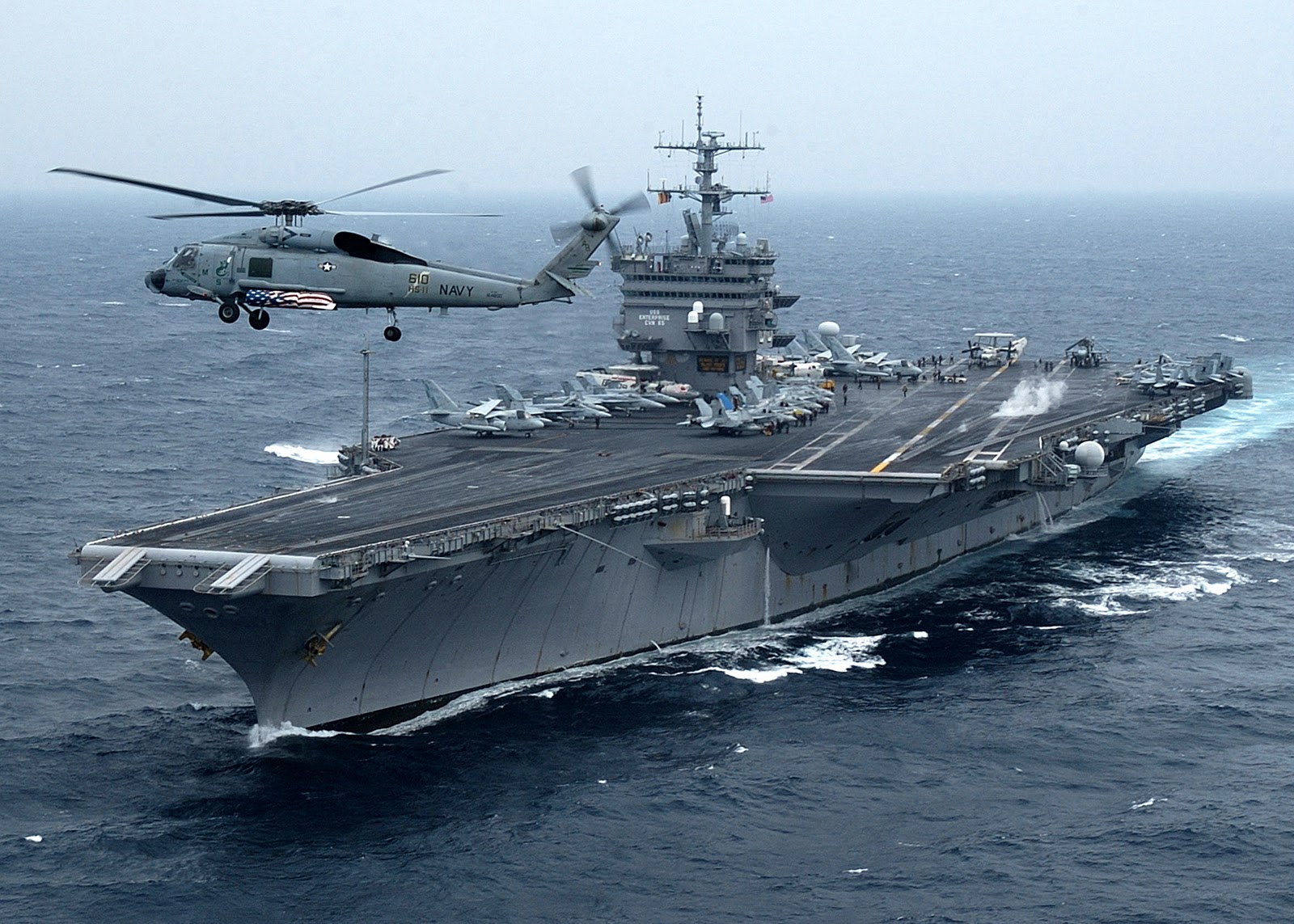
Army and Weapons | Deadly USS Enterprise (CVN-65), E = m c2 x 40  | USS Enterprise (CVN-65), formerly CVA(N)-65, is the world's first nuclear-powered aircraft carrier and the eighth US naval vessel to bear the name. Like her predecessor of World War II fame, she is nicknamed the "Big E". At 1,123 ft (342 m), she is the longest naval vessel in the world. Her 93,284 long tons (94,781 t) displacement ranks her as the 11th-heaviest supercarrier, after the 10 carriers of the Nimitz class.

Deadly USS Carl Vinson (CVN-70), Gold Eagle

Army and Weapons | Deadly USS Carl Vinson (CVN-70), Gold Eagle | The USS Carl Vinson (CVN-70) is the third United States Navy Nimitz class supercarrier named after Carl Vinson, and a congressman from Georgia. Carl Vinson's nickname is "Gold Eagle".

Deadly USS George Washington (CVN-73)

Army and Weapons | Deadly USS George Washington (CVN-73) | USS George Washington (CVN 73) is an American nuclear-powered supercarrier, the sixth ship in the Nimitz class and the fourth U.S. Navy ship named after George Washington, first president of the United States. It was built by Newport News Shipbuilding and was commissioned July 4, 1992.

Deadly USS Abraham Lincoln (CVN-72)

Army and Weapons | Deadly USS Abraham Lincoln (CVN-72) | USS Abraham Lincoln (CVN-72), is the fifth Nimitz-class supercarrier in the United States Navy. She is the second Navy ship named after former president Abraham Lincoln. Her home port is Everett, Washington.

Deadly USS Theodore Roosevelt (CVN-71), the Big Stick

Army and Weapons | Deadly USS Theodore Roosevelt (CVN-71), the Big Stick | USS Theodore Roosevelt (CVN-71) (also known by crewmembers as "the Big Stick" or within the navy simply as TR) is the fourth Nimitz-class supercarrier. Her radio call sign is Rough Rider, the name of President Theodore Roosevelt's volunteer cavalry unit during the Spanish-American War. She was launched in 1984, saw her first action during Operation Desert Storm in 1991, and is currently homeported at Newport News Shipyard, Virginia.

Deadly USS Dwight D. Eisenhower (CVN-69), The Ike

Army and Weapons | Deadly USS Dwight D. Eisenhower (CVN-69), The Ike | USS Dwight D. Eisenhower (CVN-69) ("Ike") is an aircraft carrier currently in service with the United States Navy. Commissioned in 1977, the ship is the second of ten Nimitz-class super carriers currently in service, and is the first ship named for the thirty-fourth President of the United States, Dwight D. Eisenhower. The ship was originally simply called as USS Eisenhower, as the lead ship of the Nimitz class, but the name was changed to its present form on May 25, 1970. The carrier, like all others of her class, was built at Newport News Shipbuilding Company in Virginia, with the same design as the lead ship, but the ship has been revised twice in order to adapt it to the standards of the more recently built.

Monday, October 31, 2011

Deadly The Queen Elizabeth class aircraft carriers

Army and Weapons | Deadly The Queen Elizabeth class aircraft carriers | The Queen Elizabeth class aircraft carriers (formerly CVF Future of the CV project) a two-ship class aircraft carrier built for the Royal Navy. HMS Queen Elizabeth is expected to enter service in 2020 and HMS Prince of Wales is expected to initially be held in a state of "extended readiness" after completion. HMS Queen Elizabeth will be built on a CATOBAR configuration. The construction of HMS Prince of Wales was assured by the 2010 Strategic Defence and Security Review, although its role in the immediate aftermath of the Commission is still uncertain. The vessels will displace approximately 65,600 tons, is 284 meters (932 feet) long and have a tailored air group of up to 40 aircraft. They are so far the largest warships ever built for the Royal Navy.

Deadly HMS Ark Royal

Army and Weapons | Deadly HMS Ark Royal | Built by Cammell Laird, and recorded on September 16, 1935 Ark Royal was launched on April 13, 1937. She was commissioned on November 16, 1938 as the second HMS Ark Royal. November 13, 1941 sunk by a torpedo from the German submarine U81, from Gibraltar. Designed in 1934 at the Washington Naval Treaty of limitations to apply, Ark Royal was built by Cammell Laird and Company, Ltd. in Birkenhead, England, and completed in November 1938. Her design differed from the previous aircraft carriers. Ark Royal was the first ship on which the hangars and the cockpit was an integral part of the hull, instead of an add-on or a part of the superstructure. Designed for a large number of aircraft to bear, she had two hangar deck levels. She served in a period that first saw the extensive use of sea-air power, a number of carrier tactics were developed and refined aboard Ark Royal.

Deadly HMS Invincible England Carrier Vessel

Army and Weapons | Deadly HMS Invincible England Carrier Vessel | HMS Invincible was a British light aircraft carrier, the lead ship of three in her class at the Royal Navy. She was launched on May 3, 1977 and is the seventh ship to bear the name. She saw action in the Falklands War when she was deployed with HMS Hermes, she took over as flagship of the British fleet at Hermes was sold to India. Invincible was deployed in Yugoslavia and Iraq. She was decommissioned in 2005. In February 2011 she was sold to the Turkish Leyal Ship Recycling.

Deadly Admiral Flota Sovetskovo Soyuza Kuznetsov

Army and Weapons | Deadly Admiral Flota Sovetskovo Soyuza Kuznetsov | Admiral Flota Sovetskovo Soyuza Kuznetsov (Russian: Адмирал флота Советского Союза Кузнецов "Fleet Admiral of the Soviet Union Kuznetsov"), originally called Riga, renamed Leonid Brezhnev then Tbilisi) is an aircraft cruiser (heavy aircraft missile cruiser (TAVKR) in the Russian classification) as the flagship of the Russian navy. She was originally commissioned in the Soviet Navy, and was intended for the lead ship of her class, but the only other ship of her class, Varyag, has never taken and sold to the People's Republic of China by Ukraine under the condition that they should never be altered before the fight. Kuznetsov is named after the admiral of the fleet of the Soviet Union Nikolai Kuznetsov Gerasimovich.

Sunday, October 30, 2011

Deadly USS Nimitz (CVN-68)

Army and Weapons | Deadly USS Nimitz (CVN-68) | USS Nimitz (CVN-68) is a supercarrier in the U.S. Navy, the lead ship of her class. She is one of the largest warships in the world. She was laid down, launched and commissioned as CVAN-68, but was again 68 CVN (nuclear powered aircraft carrier multi-mission) on June 30, 1975, as part of the fleet redeployment of that year.

Deadly KRI Dipenogoro, Indonesian Navy Warships

 
Army and Weapons | Deadly KRI Dipenogoro, Indonesian Navy Warships | KRI Diponegoro (365) is the first ship of the SIGMA-class corvette owned by the Navy. KRI Diponegoro as a corvette made by Schelde shipyard, the Netherlands started in 2005 specifically for the navy. Served as a patrol boat with the ability of the surface anti-ship, anti-submarine and anti-aircraft.